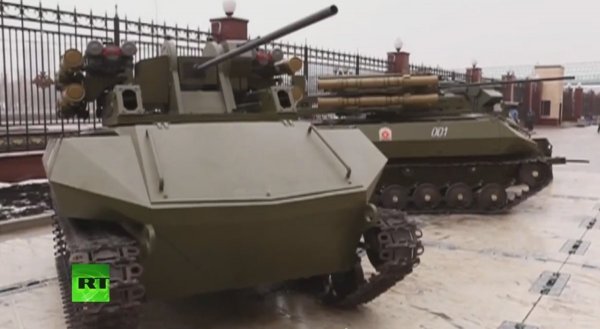
Russian AI software directs robot squad in battlefield test
A Russian defense contractor has demonstrated a battlefield control system that allows a squad of ten robots to operate without direct human input, marking a step toward fully autonomous military machines. The software, named Unicum, was developed by United Instrument Manufacturing Corporation (OPK) and has passed all tests, according to the company.
In a recent trial, the robots were assigned a leader and worked together to locate targets, choose advantageous firing positions, and request authorization from a human operator before engaging. The system also enabled the machines to call for replacements when one of their own was disabled, all without human intervention.
Sergey Skokov, OPK's deputy director, said the software is ready to be installed on any robotic platform, whether it operates on the ground, in the air, or at sea. Unicum can function independently or as part of a group, and Skokov noted that the robots can "see and evaluate the situation, plot new courses as well as communicating with other machines."
The company's broader goal is to create a full-fledged artificial intelligence that could give future machines capabilities approaching those of humans. While the current system still requires human approval for target elimination, OPK claims that the AI could eventually exclude humans from the robots' activities altogether.
How Unicum Works
Unicum is a software framework that enables robots to make decisions and act on them without human control. In the test, the robots operated as a coordinated unit, with one designated as the commander. The system allowed them to share information, adapt to changing conditions, and request support when needed.
The ability to operate in groups is a key feature, as it allows the robots to perform complex tasks that would be difficult for a single machine. The software's compatibility with different platforms—ground, air, and sea—suggests potential applications beyond the battlefield, though OPK has not disclosed specific civilian uses.
Skokov emphasized that the software has passed all tests and is ready for deployment. The company believes this is a significant step toward creating machines with near-human capabilities, but it remains unclear when or if the system will be used in active military operations.
The development comes amid broader international efforts to integrate artificial intelligence into defense systems. While autonomous weapons have been a topic of debate among policymakers and ethicists, OPK's announcement highlights the rapid pace of technological advancement in this field.
OPK has not released details about the test environment or the types of robots used, but the company's claims suggest a level of sophistication that could have implications for future military strategies. As AI continues to evolve, the line between human-controlled and autonomous systems may become increasingly blurred.
Russian defense contractor OPK has tested an AI system called Unicum that lets a squad of ten robots operate autonomously, including selecting targets and requesting human approval before firing. The software, which passed all tests, can be installed on ground, air, or sea platforms and may eventually remove humans from the loop entirely.
Leave a Comment
Comments (0)