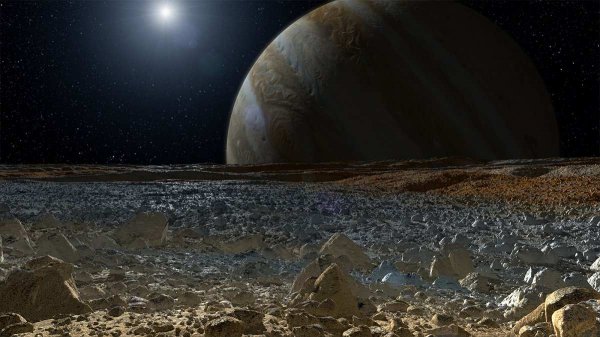
Nuclear Energy May Power Microbial Life in Europa's Hidden Ocean
Jupiter's moon Europa has long been a prime candidate in the search for life beyond Earth, and a new study from Brazilian researchers adds a novel energy source to the conversation: nuclear radiation. The findings, published in the journal Scientific Reports, suggest that microbial life could survive in Europa's subsurface ocean by harnessing energy from radioactive elements, a process observed in a deep South African mine.
The study, led by Douglas Galante at the University of São Paulo (USP), focused on the Mponeng gold mine near Johannesburg, South Africa. In this extreme environment, water seeping through the mine becomes enriched with radioactive uranium. The radiation breaks down water molecules, generating free radicals that dissolve surrounding rocks and release sulfate. Bacteria in the mine then use that sulfate as an energy source, a metabolic pathway that does not require sunlight.
"This is the first time an ecosystem has been found to survive directly on the basis of nuclear energy," Galante said in a press release. The team posits that the conditions at Mponeng mirror what might exist at the bottom of Europa's ocean, where the moon's icy crust shields a vast liquid water reservoir.
Europa is thought to contain roughly twice as much water as Earth, and its ocean floor may resemble that of early Earth. Galante noted that "studying Europa today is to some extent like looking back at our own planet in the past," offering a window into how life might originate under similar conditions elsewhere.
Implications for the Joint Europa Mission
The research arrives as NASA and the European Space Agency (ESA) prepare for a 2025 mission to Europa, dubbed the Joint Europa Mission (JEM). The mission aims to locate biosignatures of life in the moon's ocean, and the new model provides a framework for predicting what forms of life might be found. If organisms exist, they are likely to be extremophiles, adapted to high radiation and low nutrient availability.
Beyond the immediate mission, the study expands the understanding of life's resilience in the universe. By drawing parallels between Europa and early Earth, scientists hope to refine the criteria for habitability on other icy moons, such as Saturn's Enceladus, though the current work focuses specifically on Europa.
The findings also underscore the value of terrestrial analogs in astrobiology. The Mponeng mine, already known for hosting microbial life in extreme conditions, serves as a natural laboratory for testing hypotheses about extraterrestrial environments. As the JEM mission progresses, such Earth-based studies will be crucial for interpreting data from Europa's surface and subsurface.
While the mission is still years away, the research offers a tangible path forward. The next steps involve refining the model with additional data from other extreme environments on Earth and integrating those insights into the design of instruments for the Europa mission. For now, the study stands as a reminder that life finds a way, even in the most unexpected places.
New research from the University of São Paulo suggests that microbial life on Jupiter's moon Europa could derive energy from nuclear reactions, similar to bacteria found in a South African gold mine. The study, published in Scientific Reports, uses Earth-based analogs to inform the upcoming Joint Europa Mission.
Leave a Comment
Comments (0)