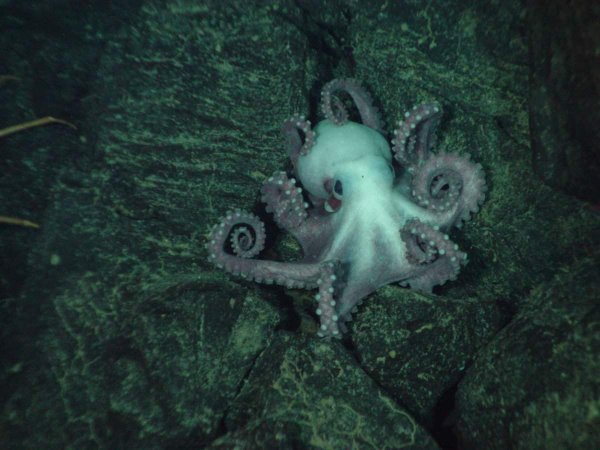
Underwater 'Octlantis' Reveals Surprising Social Lives of Octopuses
Marine researchers have uncovered a bustling underwater community of 15 Sydney octopuses off the coast of Eastern Australia, a finding that upends the long-standing notion that these cephalopods are solitary creatures. The site, located in Jervis Bay, has been nicknamed 'Octlantis' by the international team of scientists who documented the animals' frequent interactions, including mating, mate defense, and even evictions from dens.
The discovery, published in the journal Marine and Freshwater Behaviour and Physiology, was led by David Scheel of Alaska Pacific University. The researchers observed not only tolerance among the octopuses but also active signaling and attempts to exclude individuals from the site—behaviors that suggest a complex social structure.
This is not the first such finding. In 2009, scientists stumbled upon a similar gathering, dubbed 'Octopolis,' not far from Jervis Bay. That earlier discovery was initially dismissed as a fluke, but the existence of two distinct sites indicates that these octopuses are not merely meeting annually to mate.
Why Octopuses Gather
Stephanie Chancellor, a co-author of the study from the University of Illinois-Chicago, suggests that the Sydney octopuses are drawn to areas with multiple seafloor rock outcroppings, which provide ideal den-building opportunities. Over time, the octopuses have also constructed elaborate middens—piles of shells from clams and scallops they have consumed—which they further sculpt into dens. Chancellor described these creatures as 'true environmental engineers' in a press release.
The researchers plan to continue studying the factors that drive this communal behavior. Scheel told Quartz that these behaviors are 'the product of natural selection' and may be 'remarkably similar to vertebrate complex social behavior.' He added that when the right conditions arise, evolution may produce similar outcomes in diverse groups of organisms.
The existence of Octlantis and Octopolis also underscores how much remains unknown about the world's oceans. Like deep space, the ocean's depths continue to reveal surprises, reminding us that our understanding of marine life is still incomplete.
Marine biologists have discovered a bustling underwater community of 15 Sydney octopuses off the coast of Eastern Australia, challenging the long-held belief that these creatures are solitary. The site, nicknamed 'Octlantis,' shows frequent interactions, mating, and even evictions, suggesting complex social behavior that may mirror that of vertebrates.
Leave a Comment
Comments (0)