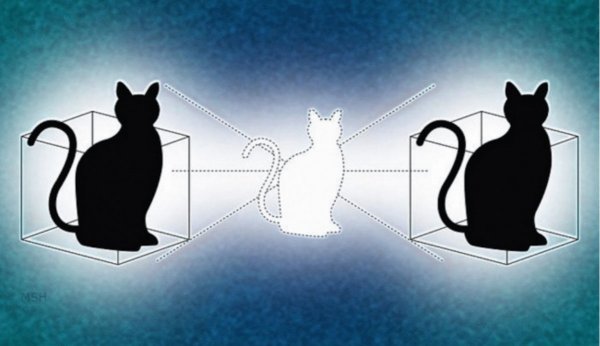
Yale Physicists Split a Quantum Cat Across Two Boxes
In a laboratory at Yale University, physicists have turned a famous thought experiment into a tangible demonstration, showing that a quantum 'cat' can exist in two separate boxes at once. The work, published in the journal Science, moves the theoretical concept of Schrödinger's cat from a philosophical puzzle to a practical tool for quantum computing.
The experiment, led by Chen Wang, used microwave photons—electromagnetic waves—instead of a real feline. These photons were placed in a 'cat state,' a quantum superposition where the wave oscillates in two opposite directions simultaneously. 'Normally, electromagnetic waves in the box will oscillate in strength, like a pendulum sweeping back and forth,' explained Joshua Sokol in New Scientist. 'But it’s possible to introduce the opposite wave into the box, creating a cat state that is doing two seemingly contradictory things at once.'
To push the concept further, the team built two aluminum cavities—the 'boxes'—and connected them with a superconducting sapphire chip and an aluminum circuit. This link acted as a tunnel that could be turned on or off, and in the quantum world, it could be both on and off at the same time. When the link was 'shut off,' the photons in the two cavities remained connected, behaving as if the cat was still whole, even though it was split.
The team measured the resulting cat states and found a fidelity of 81 percent, a metric indicating how closely the state matched the ideal. This high fidelity is crucial because cat states are more resistant to errors than other types of qubits, the basic units of quantum computers. 'One stumbling block for quantum computers is that errors inevitably slip into calculations due to interactions with the outside environment that muck up the qubits’ quantum properties,' noted Emily Conover in Science News. 'The cat states are more resistant to errors than other types of qubits, the researchers say, so the system could eventually lead to more fault-tolerant quantum computers.'
The underlying phenomenon is quantum entanglement, a concept Albert Einstein famously called 'spooky action at a distance.' In this case, the electric fields in both cavities remain in sync, ensuring that the two 'cats' are inextricably linked. This synchronization is what allows the system to function as a pair of quantum bits, or qubits, which could be scaled up for practical use.
Why This Matters for Quantum Computing
The experiment is a step toward building more reliable quantum computers. By demonstrating that cat states can be created and maintained across two cavities, the researchers have shown a potential path to error-resistant qubits. The next step is to scale the experiment to more than two boxes, which would bring the technology closer to real-world application.
The work also provides a concrete illustration of superposition, a principle that underpins quantum mechanics. While the original thought experiment was purely hypothetical, this lab demonstration offers a tangible way to study and harness quantum effects. The researchers are optimistic about scaling up, though the practical challenges remain significant.
Yale University researchers have demonstrated a real-world version of Schrödinger's cat by placing microwave photons in two linked cavities, showing the cat can exist in two boxes at once. The experiment, which achieved 81% fidelity, could lead to more fault-tolerant quantum computers.
Leave a Comment
Comments (0)